From language to language
The story of generative AI is usually told as a story of breakthroughs. There was the Transformer paper in 2017, the GPT line, a string of scaling laws, the surprise of in-context learning, then the cultural detonation of ChatGPT. Each of those moments matters. But the deeper story is about a single bet — that more data, more parameters, and more compute would continue to produce qualitatively new capabilities.
That bet, made explicitly by a small group of researchers in the mid-2010s, is the founding act of the field as we know it today. Almost everything else — the products, the lawsuits, the boardroom coups, the press cycles — is downstream of that wager.
The transformer, plainly
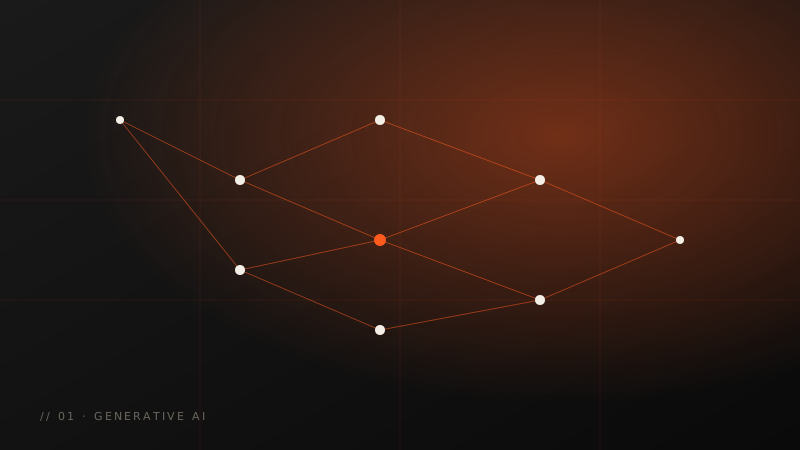
The Transformer is a startlingly simple architecture. Take a sequence of tokens, embed them in a high-dimensional space, then repeatedly apply two operations: attention, which lets every position look at every other position, and a position-wise feed-forward network, which processes each position independently. Stack enough of these blocks, train on enough text, and the resulting model develops the ability to predict the next token with eerie competence.
That is, more or less, the whole story. The cleverness is not in any single piece — it is in the realization that this minimal structure, scaled, can absorb the structure of language itself.
Attention(Q, K, V) = softmax(Q Kᵀ / √d) VThe equation above is the heart of modern language modeling. It says: to compute a new representation of token i, take a weighted average of all other tokens, where the weights are determined by how relevant each one is to i. That is the entire "reasoning" mechanism of a large language model — and it is, on paper, a one-line formula.
Diffusion and the image
While Transformers were eating language, a different architecture was quietly taking over images. Diffusion models learn to invert a process of progressive noise: at training time, you destroy an image by adding Gaussian noise over a thousand steps; at sampling time, you learn to walk that destruction backward, one denoising step at a time.
The result, after a few years of refinement, was Stable Diffusion, DALL·E, Imagen, and Midjourney — systems that can synthesize a photoreal image from a sentence, or extrapolate a video from a single frame. The visual revolution of 2022–2024 was a diffusion revolution.
A diffusion model is, in a real sense, a sculptor working only in marble dust. Its medium is noise; its craft is the negative space from which an image emerges. — RESEARCH NOTE, 2025
Multimodal convergence
The two stories converged in 2024–2026. Text-only models learned to see; image models learned to read. Today's frontier systems are trained on mixed streams of text, images, audio, video, and — increasingly — actions, trajectories, and tool use. The boundary between "language model", "vision model", and "agent" is dissolving.
This convergence is the deepest reason to take generative AI seriously as a civilizational shift, not a product cycle. We are not building five separate AIs; we are building one model that can talk, draw, listen, and act — and the integration is happening faster than any of its builders expected.
What it cannot do
For all the noise, the honest map of capability has clear edges. Generative models do not know things in the way humans do — they have no model of the world, no persistent memory, no privileged access to truth. They are extraordinarily fluent and fundamentally unreliable. They hallucinate confidently. They fail silently. They inherit the biases of their training data with no way to inspect or correct them.
The next decade of generative AI will be defined less by what these systems can generate and more by what we can trust them to generate. That is an engineering problem, a research problem, and a political problem — and it is the work that has only just begun.
Filed under: Generative AI · Transformers · Diffusion · Multimodal
Cite as: Editorial Team (2026). The Dawn of Generative AI. Signal, Vol. 1, Issue 12.